Games influenced by Star Wars CCG
Games influenced by Star Wars CCG reuse the rules of Decipher's Star Wars Customizable Card Game (SWCCG) or borrow its mechanics. Decipher built WARS (2004) on the SWCCG game system. The Lord of the Rings Trading Card Game (2001) used uniqueness dots. Players Committee designer Ryan Jellison says the My Little Pony Collectible Card Game (2013) copied SWCCG's battle destiny.[1][2]
Decipher games
Young Jedi

Young Jedi (1999) was a simpler Phantom Menace game for younger players.[3] SWCCG designers Tom Braunlich and Rollie Tesh said destiny numbers, location-based play and depleting the opponent's Force were hallmarks "that will be in all of our games".[4] Designer Chuck Kallenbach said "a real 'bridge' from Young Jedi to SWCCG was not intended."[3]
Jedi Knights Trading Card Game

Kallenbach designed the Jedi Knights Trading Card Game (2001) with Tom Lischke. Asked whether it drew on Decipher's best mechanics, he said: "It was filled with stuff that Tom and I liked."[3]
WARS Trading Card Game

After Lucasfilm moved the Star Wars card game license to Wizards of the Coast, Decipher kept its game mechanics. Lucasfilm had the right to license them for the new game but chose not to.[5][6] In 2004 Decipher announced a game "built on the mechanics Decipher developed for its best-selling Star Wars CCG", set in its own universe.[2] It launched as WARS on 6 October 2004.[7] Warren Holland said he "got thousands and thousands of emails from people that wanted us to bring back the Star Wars mechanics".[8]
The Lord of the Rings Trading Card Game
Decipher's The Lord of the Rings Trading Card Game (2001) used uniqueness dots.[9][10] Unique cards print a uniqueness dot (•) before the title; non-unique cards do not.[10] Aragorn, Ranger of the North and Obi-Wan Kenobi have a uniqueness dot; Goblin Runner and Stormtrooper do not. Each draw deck mixes Free Peoples and Shadow cards, with equal counts, behind one card back.[10]
-
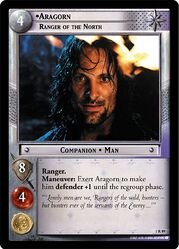 Aragorn, Ranger of the North (The Fellowship of the Ring, 2001).
-
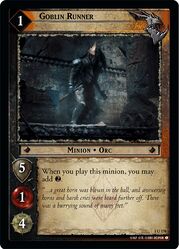 Goblin Runner (The Fellowship of the Ring, 2001).
-
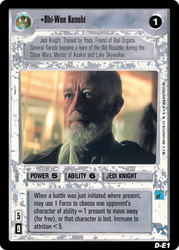 Obi-Wan Kenobi (Premiere, 1995).
-
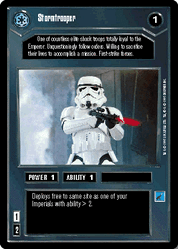 Stormtrooper (Premiere, 1995).


My Little Pony Collectible Card Game


Enterplay published the My Little Pony Collectible Card Game from 2013. Its lead designer was Darrell Hardy.[11] Enterplay's founder and president, Dean Irwin, had been Decipher's sales director, "responsible for all their global sales".[12]
Jellison said the game "was designed by people who worked at Decipher". He pointed to its mechanics: "you draw battle destiny in the game ... and there's a destiny number on it."[1]
In a My Little Pony faceoff, each player adds "the power of the top card of your deck" to the power of their cards in the contest.[11] Players "ignore everything on the card except its power value", so the printed power number works like an SWCCG destiny number.[11] A tie means both players flip again.[11]
Jellison compared the game's pair cards to Gift Of The Mentor, which adds two battle destiny when Luke and Obi-Wan or Yoda battle together: "It's also destiny five. It's like a direct copy."[1] The Brave and the Bold flips one additional card when Rainbow Dash or Applejack is in the faceoff, and two when both are. Its flip value is 5.[13] The Premiere set's pair cards, such as Team Effort, have power 4.[13]
Borrowing into SWCCG
The Players Committee designs new virtual cards. Jellison said some of them borrow from other games: "There are Pokemon inspired cards ... There are also Game of Thrones, and Lord of the Rings", and "it's really easy to borrow from My Little Pony, honestly."[1]
See also
- Inspirations for Star Wars CCG
- Design of Star Wars CCG
- Decipher after the Star Wars license
- The Lord of the Rings Trading Card Game
- Uniqueness
- SWCCG 2nd Edition
References
- ↑ 1.0 1.1 1.2 1.3 SWCCG PDS2: Ryan Jellison PC Designer Interview, ISB Troopers, HB Capital Weapons, Bill Bisco (YouTube, 18 May 2025), 36:44–38:44. Preserved copy: Internet Archive
- ↑ 2.0 2.1 Decipher Plans Two New CCGs, ICv2 (23 March 2004). Preserved copy: Internet Archive
- ↑ 3.0 3.1 3.2 Josh Radke, Flashback: Chuck Kallenbach interview, TheForce.Net. Preserved copy: Internet Archive
- ↑ Radio Free Decipher 16: Tom Braunlich and Rollie Tesh, part 2, Decipher, interview by Carol Wisely (30 April 1999), 03:25–03:44. Preserved copy: Internet Archive
- ↑ Wizards of the Coast Gets Star Wars CCG, ICv2 (1 January 2002). Preserved copy: Internet Archive
- ↑ Radio Free Decipher special: Warren Holland, Decipher, interview by Kyle Heuer (28 December 2001), 17:45–17:53. Preserved copy: Internet Archive
- ↑ Decipher Declares WARS, ICv2 (2 May 2004). Preserved copy: Internet Archive
- ↑ Decipher WARS Radio 3: Warren Holland Interview, Decipher, host Mark Tuttle (9 July 2004), 00:55–01:30. Preserved copy: Internet Archive
- ↑ Unique, LOTR-TCG Wiki. Preserved copy: Internet Archive
- ↑ 10.0 10.1 10.2 Comprehensive Rules 4.2, LOTR-TCG Wiki, unique and non-unique. Preserved copy: Internet Archive
- ↑ 11.0 11.1 11.2 11.3 My Little Pony Collectible Card Game rulebook, Enterplay (2013), pp. 2–4 and credits. Heart of the Cards copy. Preserved copy: Internet Archive
- ↑ Jim McLauchlin, Business 3x3: Dean Irwin, Recently of Enterplay, ICv2 (19 February 2020). Preserved copy: Internet Archive
- ↑ 13.0 13.1 PonyHead card database, cards PR121 and CN119. Preserved copy: Internet Archive